
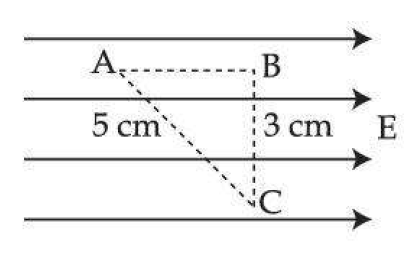
Three points A, B and C lie in a uniform Electric field E of \( 2 \times 10^{3}\,\mathrm{N/C} \) as shown in figure. Find the potential difference between points A and C is :
Answer & explanation
Correct answer: option 3
The correct answer is Option (3) → 80 V
In a uniform field the potential falls only along the field, so the potential difference depends on the displacement measured along the field lines: \( V_A - V_C = E\,d \), where \( d \) is the component of AC along \( \vec{E} \).
BC is perpendicular to the field lines, so B and C lie on the same equipotential and \( V_B = V_C \). Only the part AB, along the field, counts. From the right triangle ABC:
\( AC = 5\,\mathrm{cm} \)
\( BC = 3\,\mathrm{cm} \)
\( \displaystyle AB = \sqrt{AC^{2} - BC^{2}} = \sqrt{25 - 9}\,\mathrm{cm} = 4\,\mathrm{cm} = 0.04\,\mathrm{m} \)
\( \displaystyle V_A - V_C = E \times AB = 2\times10^{3}\,\mathrm{N/C} \times 0.04\,\mathrm{m} = 80\,\mathrm{V} \)
A is upstream of C along the field, so A is at the higher potential.