CUETMOCK
  • Pricing
  • Mentors
Log inStart freeStart free mocks→

First test, then trust

Try a free CUET mock test.

Join 5,00,000+ students who rehearsed exam day on the exact NTA screen before sitting CUET. On the web and on Android.

Start free mocks →Get the Android app
CUETMOCK

India's #1 CUET Mock Test Platform. Original NCERT-based questions on the exact NTA exam screen — trusted by 5,00,000+ students since CUET 2022.

Get it onGoogle PlayScan to download the CUETMOCK app

Mock tests

  • CUET mock test series
  • Browse all papers
  • Commerce mocks
  • Humanities (Arts) mocks
  • Science mocks
  • Languages & GAT mocks
  • Free practice questions
  • Pricing

Resources

  • CUET exam guide
  • CUET syllabus
  • Universities accepting CUET
  • Expert blogs
  • News & notifications
  • Webinars & counselling
  • CUET score calculator
  • How we estimate your rank
  • FAQs

Company

  • About us
  • Our leadership & team
  • Our toppers
  • Mentors
  • For schools
  • Contact us
  • Terms
  • Privacy
  • Refund policy

Talk to us

+91 7696 6630 56info@cuetmock.comWhatsApp us

Our other platforms

  • JEE Mock — For IIT-JEE aspirants
  • NEET Mock — For NEET aspirants

Newsletter

Exam updates, study material and offers — no spam.

© 2026 NYC Ventures Pvt. Ltd.

701-702, Royal Business Park, Zirakpur, Punjab - 140603

  • Terms of use
  • Privacy policy
  • Refund policy
  • Contact us

iCUETMOCK is an independent preparation platform, not affiliated with the National Testing Agency (NTA). Always check exam details on the official NTA website.

  • Home
  • Mock tests
  • CUET guide
  • Pricing
  • Log in
Home/Practice questions/Economics
EconomicsMicro Economics: Theory of Firms under Perfect Competition

In a perfectly competitive market, a firm produces and sells a certai…

In a perfectly competitive market, a firm produces and sells a certain amount of goods. Among the following what reflect the firm's profit?

Answer & explanation+

Correct answer: option 2

The correct answer is Option (2) → Total Revenue - Total Cost.

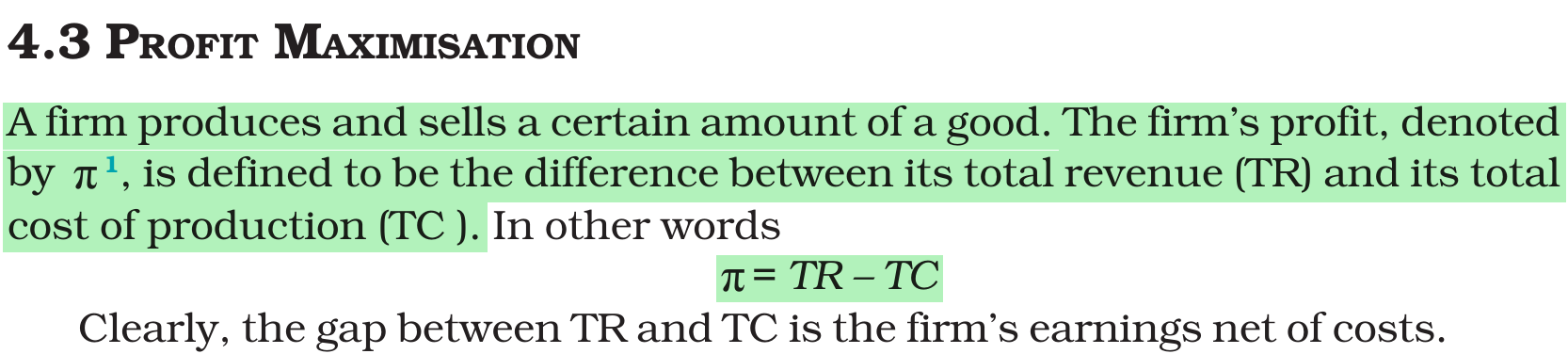
A firm’s profit is the difference between its total revenue and its total cost.

Total revenue is the market price multiplied by the quantity sold. Total cost is what the firm spends to produce that quantity, and it is made up of fixed cost and variable cost.

NCERT (2026-27): Introductory Microeconomics — Chapter 4: The Theory of the Firm under Perfect Competition

NCERT extract

NCERT extract

NCERT (2026-27): Introductory Microeconomics — Chapter 3: Production and Costs

NCERT extract

Advertisement

Practise more on Micro Economics: Theory of Firms under Perfect Competition

Chapter-wise mocks on the real NTA exam screen, with solutions and your rank. Your first mocks are free.

Start free mocks →

Advertisement

Next questions

  1. The city of _______ is located at the mouth of the Yangtze River.General Aptitude Test · General Knowledge
  2. Which of the following is a feature of a company?Accountancy Part A · Accounting for Shares
  3. Which of the following countries has not made legal claims to sovereign rights over the territory shown in the picture above?Political Science · Contemporary World Politics: Environment and Natural Resources
  4. Ashok invests in Rs 25 shares selling at Rs 36 and obtaining an income of RS 7220. If the company declared dividend of 12%, find the number…Applied Maths. Section B2 · Financial Mathematics
  5. Which two parameters from the following are plotted to give a straight line on Freundlich adsorption isotherm?Chemistry · Physical: Surface Chemistry
  6. Which organism was first used to show semiconservative replication of DNA?Biology · Molecular Basis of Inheritance
  7. Identify the Artist of Bengal School as described "He was a descendant of Ustad Ahmed, the Chief Architect of Shah Jahan".Fine Arts · The Bengal School and Cultural Nationalism
  8. Select the option that can be used as a one-word substitute for the given group of words. A small organised dissenting group within a large…English · One Word
  9. Accountability arises from :Business Studies · Organising
  10. The Right to Information Act 2005 specifies that citizens have a right to: (A) Request any information (as defined)(B) To get a reply to th…Sociology · Indian Society: Challenges of Cultural Diversity