If the \( E_{\text{cell}}^{\circ} \) of the given hypothetical cell reaction is 0.046 V, the value of \( \log K_{c} \) for this reaction at 298 K would be:
\( \text{A(s)}+2\text{B}^{+}(aq)\rightarrow\text{A}^{2+}(aq)+2\text{B(s)} \)
Answer & explanation
Correct answer: option 1
The correct answer is Option (1) → 1.556
At equilibrium the cell potential becomes zero, and the Nernst equation then links the standard cell potential to the equilibrium constant. At 298 K:
\( \displaystyle E^\circ_{\text{cell}} = \frac{0.0591}{n}\log K_c \)
\( \displaystyle \log K_c = \frac{n\,E^\circ_{\text{cell}}}{0.0591} \)
The number of electrons, n, comes from the half-reactions:
\( \displaystyle \ce{A(s) -> A^2+(aq) + 2e^-} \)
\( \displaystyle \ce{2B^+(aq) + 2e^- -> 2B(s)} \)
So n = 2. Substituting \( E^\circ_{\text{cell}} = 0.046\ \mathrm{V} \):
\( \displaystyle \log K_c = \frac{2 \times 0.046}{0.0591} = \frac{0.092}{0.0591} \approx 1.556 \)
So log Kc = 1.556, which gives \( K_c \approx 36 \). (With the rounded factor 0.059 V the result is 1.559, still closest to Option (1).)
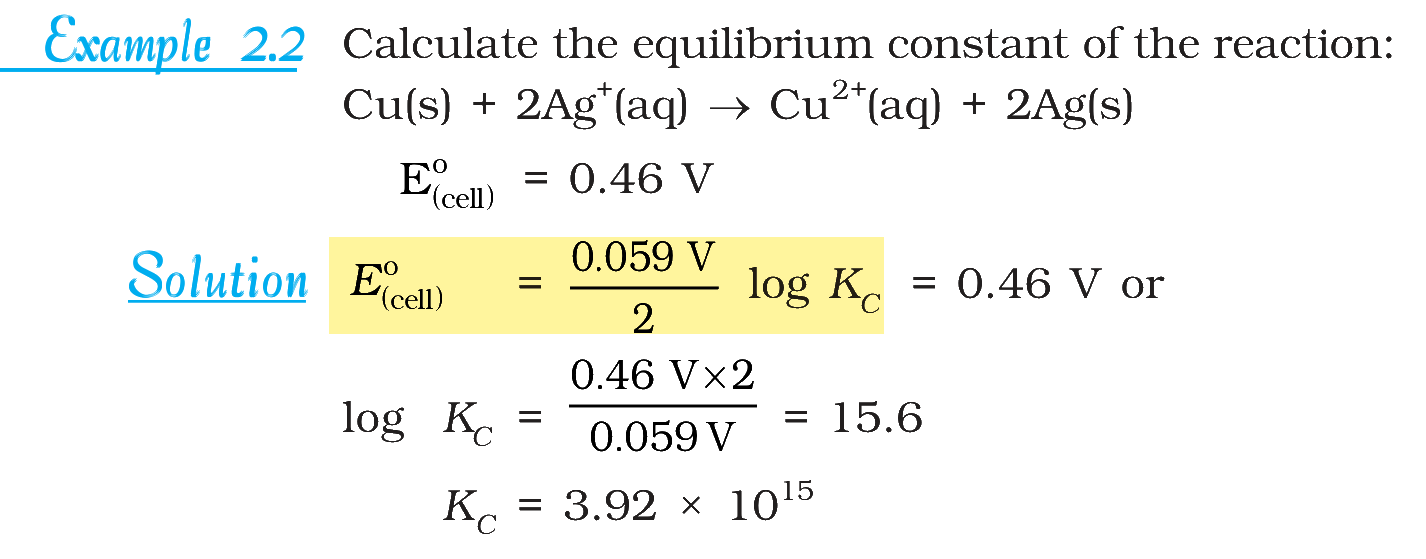
Note: NTA picked this question from an NCERT (2026-27) example and changed the figures. Do not ignore NCERT while practising numericals.
NCERT (2026-27 edition):
Equilibrium Constant from Nernst Equation – …