
CUETMOCK
  • Pricing
  • Mentors
Log inStart freeStart free mocks→

First test, then trust

Try a free CUET mock test.

Join 5,00,000+ students who rehearsed exam day on the exact NTA screen before sitting CUET. On the web and on Android.

Start free mocks →Get the Android app
CUETMOCK

India's #1 CUET Mock Test Platform. Original NCERT-based questions on the exact NTA exam screen — trusted by 5,00,000+ students since CUET 2022.

Get it onGoogle PlayScan to download the CUETMOCK app

Mock tests

  • CUET mock test series
  • Browse all papers
  • Commerce mocks
  • Humanities (Arts) mocks
  • Science mocks
  • Languages & GAT mocks
  • Free practice questions
  • Pricing

Resources

  • CUET exam guide
  • CUET syllabus
  • Universities accepting CUET
  • Expert blogs
  • News & notifications
  • Webinars & counselling
  • CUET score calculator
  • How we estimate your rank
  • FAQs

Company

  • About us
  • Our leadership & team
  • Our toppers
  • Mentors
  • For schools
  • Contact us
  • Terms
  • Privacy
  • Refund policy

Talk to us

+91 7696 6630 56info@cuetmock.comWhatsApp us

Our other platforms

  • JEE Mock — For IIT-JEE aspirants
  • NEET Mock — For NEET aspirants

Newsletter

Exam updates, study material and offers — no spam.

© 2026 NYC Ventures Pvt. Ltd.

701-702, Royal Business Park, Zirakpur, Punjab - 140603

  • Terms of use
  • Privacy policy
  • Refund policy
  • Contact us

iCUETMOCK is an independent preparation platform, not affiliated with the National Testing Agency (NTA). Always check exam details on the official NTA website.

  • Home
  • Mock tests
  • CUET guide
  • Pricing
  • Log in
Home/Practice questions/Chemistry
ChemistryInorganic: Coordination Compounds

[Fe(CO)5] and [Ni(CN)6] do not show similarity in

[Fe(CO)5] and [Ni(CN)6] do not show similarity in

Answer & explanation+

Correct answer: option 1

The correct answer is option 1. participation of d-orbital in hybridization.

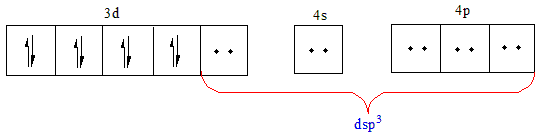
Hybridization of Fe in [Fe(CO)5] is dsp3 while hybridization of Ni in [Ni(CO)4] is sp3.

\([Fe(CO)_5]\)

\(CO\) is a strong field ligand hence pairing occurs.
\([Ni(CO)_4]\)

The electronic configuration of Ni is

\(Ni = _{18}Ar]4s^2 3d^8\)

After pairing
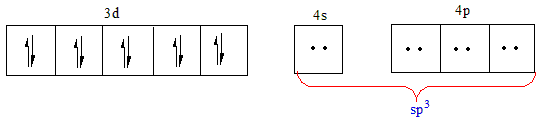
Hence, in \([Ni(CO)4]\), there is no participation of d-orbital in hybridization.

Advertisement

Practise more on Inorganic: Coordination Compounds

Chapter-wise mocks on the real NTA exam screen, with solutions and your rank. Your first mocks are free.

Start free mocks →

Advertisement

Next questions

  1. Match the idioms in List-I with their meanings in List-II.List-I (Idioms)List-II (Meanings)(A) The thin end of the wedge(I) something that…English · Grammar: Idioms
  2. Which one of the following is referred to as the seasonal migration of Bakarwals, Gujjars, Gaddis and Bhotiyas from plains to mountains and…Geography · Fundamentals of Human Geography: Primary Activities
  3. Which bodies were set up in this period to promote the nationalist creed in the territories the worker entered, the princely states?History · Modern India: Mahatma Gandhi and the Nationalist movement
  4. Which of the following land use category has witnessed the highest increase in India since independence?Geography · India-People and Economy: Land resources and Agriculture
  5. The minimum age to qualify for the President's post isGeneral Aptitude Test · General Knowledge
  6. Arrange the given layers of a microsporangium in the correct order from outside to inside.(A) Epidermis(B) Tapetum(C) Middle layers(D) Endo…Biology · Sexual Reproduction in Flowering Plants
  7. Point out the odd one from the given options.Biology · Sexual Reproduction in Flowering Plants
  8. How many triangles are there in the given figure?General Aptitude Test · Verbal Reasoning
  9. Before selecting employees for her organisation, an employer meets each applicant on a one-to-one basis and asks questions to seek informat…Psychology · Variations in Psychological Attributes
  10. Which of the following statements about competition in nature are correct? A. The Abingdon tortoise in the Galapagos Islands became extinct…Biology · Organisms and Populations