Read the passage and answer the question:
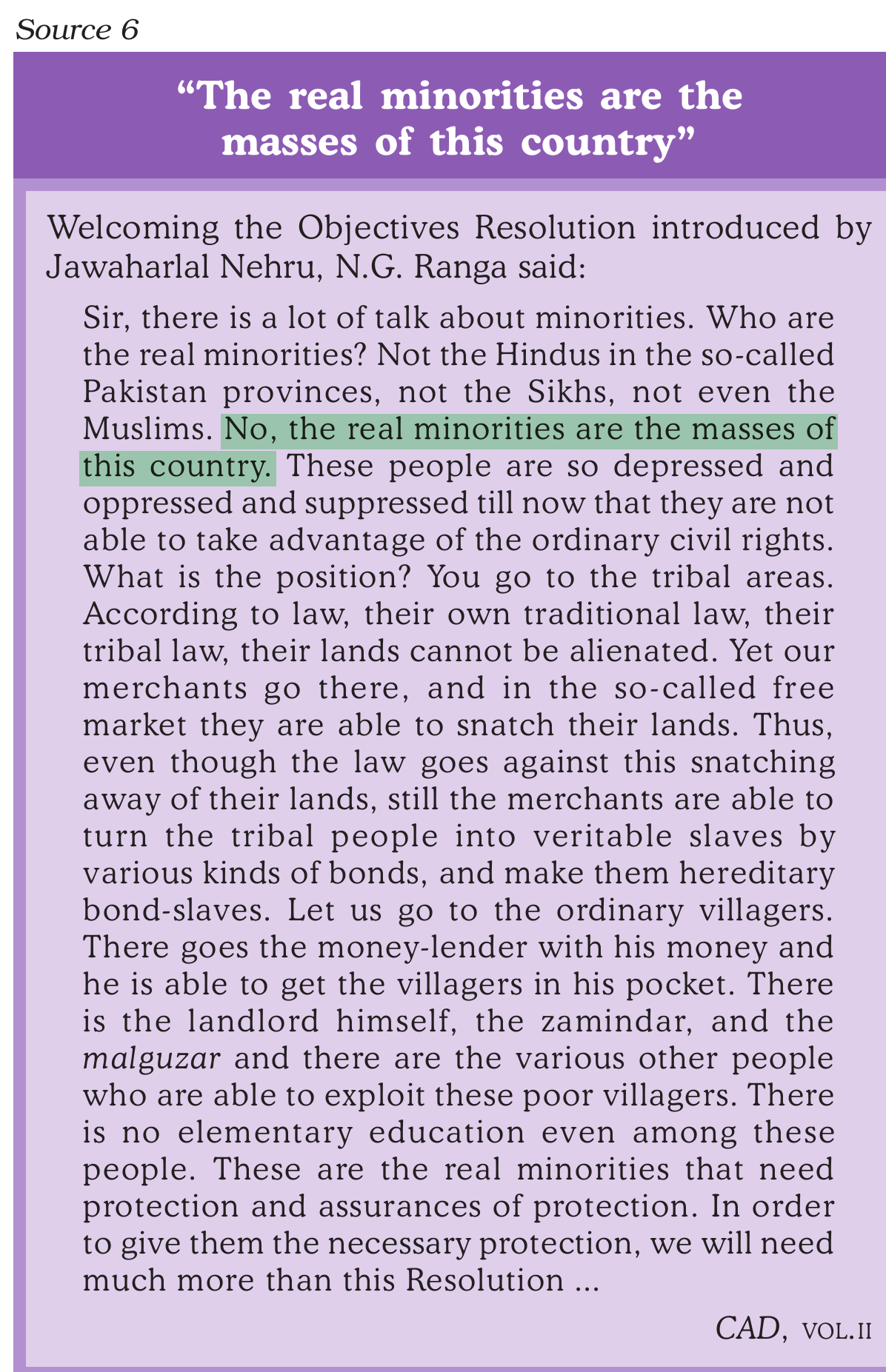
Sir, there is a lot of talk about minorities. Who are the real minorities? Not the Hindus in the so-called Pakistan provinces, not the Sikhs, not even the Muslims. No, the real minorities are the masses of this country. These people are so depressed and oppressed and suppressed till now that they are not able to take advantage of the ordinary civil rights.
According to the speech, the speaker is urging the Constituent Assembly to interpret minorities in ______.
Answer & explanation
Correct answer: option 3
The correct answer is Option (3) → Economic terms
The speaker, N.G. Ranga, sets aside the usual meaning of ‘minorities’ and says that the real minorities are the masses of this country. In the full speech (Source 6) he goes on to describe them as the poor tribals and villagers exploited by merchants, money-lenders and landlords.
Option (1) Social terms — Incorrect. Ranga does not mark out any caste or social group. His minorities are the poor tribals and villagers, whatever community they belong to.
Option (2) Political terms — Incorrect. He welcomes the legal rights the Constitution grants but says the poor cannot even use their ordinary civil rights; he does not count minorities by their political strength.
Option (3) Economic terms — Correct. Ranga, a socialist who had led the peasant movement, urged that the term minorities be interpreted in economic terms: the real minorities were the poor and the downtrodden.
Option (4) Religious terms — Incorrect. This is the very meaning he rejects: the real minorities are “not the Hindus … not the Sikhs, not even the Muslims”.
NCERT (2026-27): “3.2 ‘We will need much more than this Resolution’ … While welcoming the Objectives Resolution, N.G. Ranga, a socialist who had been a leader of the peasant movement, urged that the term minorities be interpreted in economic terms. The real minorities for Ranga were the poor and the downtrodden. He welcomed the legal rights the Constitution was granting to each individual but pointed to its limits. In his opinion it was meaningless for the poor people in the villages to know that they now had the fundamental right to live, and to have full employment, or that they could have their meetings, their conferences, their associations and various other civil liberties. It was essential to create conditions where these constitutionally enshrined rights could be effectively enjoyed. For this they needed protection. ‘They need props. They need a ladder,’ said Ranga.”
|