
A kite is moving horizontally at a height of 151.5 m. If the speed of kite is 10 m/s, how fast is the string being let out, when the kite is 250 m away from the boy who is flying the kite, if the height of boy is 1.5 m?
Answer & explanation
Correct answer: option 2
The correct answer is Option (2) → 8 m/s ##
We have, height $(h) = 151.5 \text{ m}$, speed of kite $(v) = 10 \text{ m/s}$
Let $CD$ be the height of kite and $AB$ be the height of boy.
Let $DB = x \text{ m} = EA$ and $AC = 250 \text{ m}$
$∴\frac{dx}{dt} = 10 \text{ m/s}$
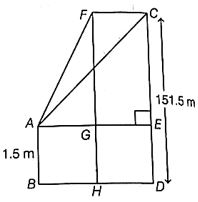
From the figure, we see that
$EC = CD - ED \Rightarrow CD - AB$ [$∵ED = AB$]
$EC = 151.5 - 1.5 = 150 \text{ m}$
and $AE = x$ [$∵DB = AE$]
Also, $AC = 250 \text{ m}$
In right angled $\triangle CEA$,
$AE^2 + EC^2 = AC^2$
$\Rightarrow x^2 + (150)^2 = y^2 \dots(i)$
$\Rightarrow x^2 + (150)^2 = (250)^2$
$\Rightarrow x^2 = (250)^2 - (150)^2$
$= (250 + 150)(250 - 150) = 400 \times 100$
$∴x = 20 \times 10 = 200$
From Eq. (i), on differentiating w.r.t. $t$, we get
$2x \cdot \frac{dx}{dt} + 0 = 2y \frac{dy}{dt}$
$\Rightarrow 2y \frac{dy}{dt} = 2x \frac{dx}{dt}$
$∴\frac{dy}{dt} = \frac{x}{y} \frac{dx}{dt}$
$= \frac{200}{250} \cdot 10 = 8 \text{ m/s}$ $[∵\frac{dx}{dt}=10\,m/s]$
So, the required rate at which the string is being let out is 8 m/s.