
The tailors A and B are paid ₹225 and ₹300 per day respectively. A can stitch 9 shirts and 6 pants while B can stitch 15 shirts and 6 pants per day. Form a linear programming problem to minimize the labour cost to produce atleast 90 shirts and 48 pants. Solve the problem graphically.
Answer & explanation
Correct answer: option 3
The correct answer is Option (3) → ₹2025
Let the tailor A work for x days and tailor B work for y days, then the total labour cost $Z = 225x + 300y$ (in ₹).
The problem can be formulated as an L.P.P. as follows:
Minimize $Z = 225x + 300y$ subject to the constraints
$9x+15y ≥ 90$ i.e. $3x + 5y ≥ 30$
$6x+6y≥ 48$ i.e. $x + y ≥ 8,$
$x ≥ 0, y ≥0$
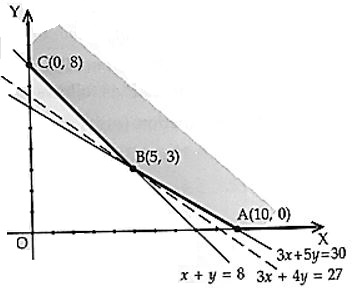
To solve this problem graphically, we draw the lines $3x + 5y = 30$ and $x + y = 8$.
The feasible region (unbounded, convex) is shown shaded in the given figure. The corner points are A(10, 0), B(5, 3) and C(0, 8).
At the corner points, the values of $Z = 225x + 300y$ are:
at $A(10, 0), Z = 225 ×10 + 300 ×0 = 2250,$
at $B(5, 3), Z = 225 ×5 + 300 × 3 = 2025,$
at $C(0, 8), Z = 225 ×0 + 300 × 8 = 2400$.
Thus, the values of Z (labour cost) at the corner points are ₹2250, ₹2025, ₹2400.
As the feasible region is unbounded, we draw the graph of the half-plane $225x + 300y < 2025$ i.e. $3x + 4y < 27$ and note that there is no point common with the feasible region, therefore, Z has minimum value. Minimum value of Z is ₹2025 and it occurs at the point B(5, 3).
Hence, the labour cost is minimum when A works for 5 days and B works for 3 days; and the minimum labour cost is ₹2025.