CUETMOCK
  • Pricing
  • Mentors
Log inStart freeStart free mocks→

First test, then trust

Try a free CUET mock test.

Join 5,00,000+ students who rehearsed exam day on the exact NTA screen before sitting CUET. On the web and on Android.

Start free mocks →Get the Android app
CUETMOCK

India's #1 CUET Mock Test Platform. Original NCERT-based questions on the exact NTA exam screen — trusted by 5,00,000+ students since CUET 2022.

Get it onGoogle PlayScan to download the CUETMOCK app

Mock tests

  • CUET mock test series
  • Browse all papers
  • Commerce mocks
  • Humanities (Arts) mocks
  • Science mocks
  • Languages & GAT mocks
  • Free practice questions
  • Pricing

Resources

  • CUET exam guide
  • CUET syllabus
  • Universities accepting CUET
  • Expert blogs
  • News & notifications
  • Webinars & counselling
  • CUET score calculator
  • How we estimate your rank
  • FAQs

Company

  • About us
  • Our leadership & team
  • Our toppers
  • Mentors
  • For schools
  • Contact us
  • Terms
  • Privacy
  • Refund policy

Talk to us

+91 7696 6630 56info@cuetmock.comWhatsApp us

Our other platforms

  • JEE Mock — For IIT-JEE aspirants
  • NEET Mock — For NEET aspirants

Newsletter

Exam updates, study material and offers — no spam.

© 2026 NYC Ventures Pvt. Ltd.

701-702, Royal Business Park, Zirakpur, Punjab - 140603

  • Terms of use
  • Privacy policy
  • Refund policy
  • Contact us

iCUETMOCK is an independent preparation platform, not affiliated with the National Testing Agency (NTA). Always check exam details on the official NTA website.

  • Home
  • Mock tests
  • CUET guide
  • Pricing
  • Log in
Home/Practice questions/Economics
EconomicsMicro Economics: Theory of Firms under Perfect Competition

What is the shape of Average Revenue (AR) curve under perfect competi…

What is the shape of Average Revenue (AR) curve under perfect competition?

Answer & explanation+

Correct answer: option 1

The correct answer is Option (1) → Horizontal straight line.

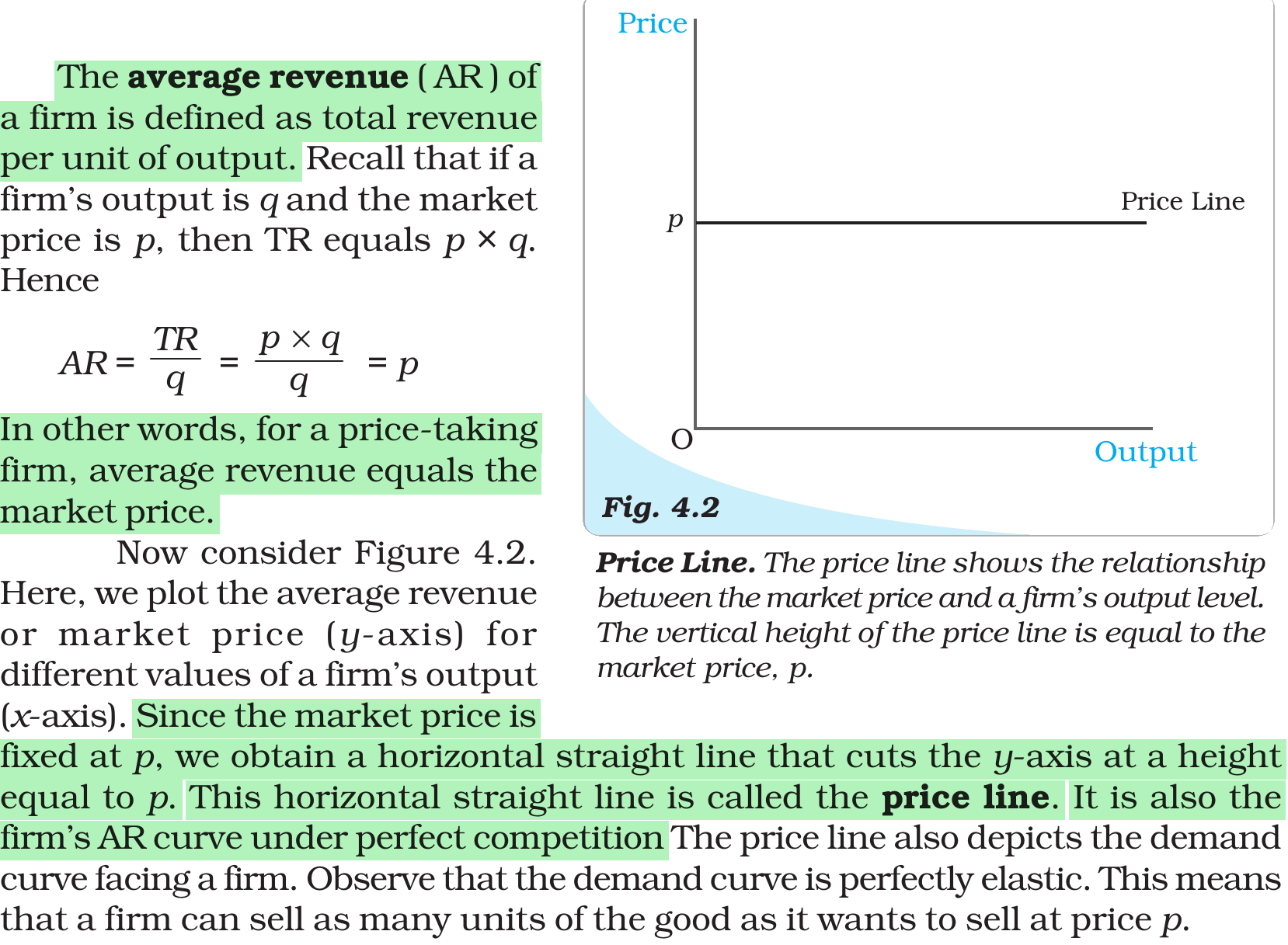
Under perfect competition, a firm is a price-taker. It sells every unit at the same market price, so its average revenue (AR) equals that price at every output.

AR is total revenue per unit of output. Total revenue is p × q, so AR = (p × q) ÷ q = p. Since p does not change with the firm’s output, the AR curve is a horizontal straight line at the market price. It is also called the price line.

NCERT (2026-27): Introductory Microeconomics — Chapter 4: The Theory of the Firm under Perfect Competition

NCERT extract

Advertisement

Practise more on Micro Economics: Theory of Firms under Perfect Competition

Chapter-wise mocks on the real NTA exam screen, with solutions and your rank. Your first mocks are free.

Start free mocks →

Advertisement

Next questions

  1. In a code language, if APTITUDE is written as ADEIPTTU, then how will ATTITUDE be written in the same language?General Aptitude Test · Verbal Reasoning
  2. Statement I: Once lymphocytes have matured, they relocate to secondary lymphoid organs such as the spleen, lymph nodes, tonsils, Peyer's pa…Biology · Human Health and Disease
  3. Choose the option that gives the correct meanings of the given pair of words, in the same order:Faint, FeintEnglish · Homonyms
  4. What is the single equivalent price increase for two successive price increase of 5% and 8% on an item?General Aptitude Test · Numerical Ability
  5. Choose the correct synonym of the given word:- SatiateEnglish · Synonyms
  6. The reagent used in the Hinsberg test of primary, secondary and tertiary amines, isChemistry · Organic: Amines
  7. In 1943, some young artists in Calcutta formed the Calcutta Group. Consider the following statements:(A) The group was formed under the lea…Fine Arts · The Modern Indian Art
  8. Find the domain of f(x)=√(log_0.4((x-1)/(x+5))).Maths. Section B1 · Relations and Functions
  9. Select the word with the correct spelling.English · Spelling Check
  10. The constraints to the LPP are: A. 3x + 2y ≤ 720 B. 2x + 3y ≤ 720 C. x + y ≤ 300 D. x ≥ 0 and y ≥ 0 E. x + y ≥ 300 Choose the correct answe…Maths. Section B1 · Linear Programming