The probability that A speaks the truth is \(\displaystyle\frac{4}{5}\). He throws a die and reports that it is a five. The probability that it is actually a five is:
Answer & explanation
Correct answer: option 1
The correct answer is Option (1) → \(\displaystyle\frac{4}{9}\)
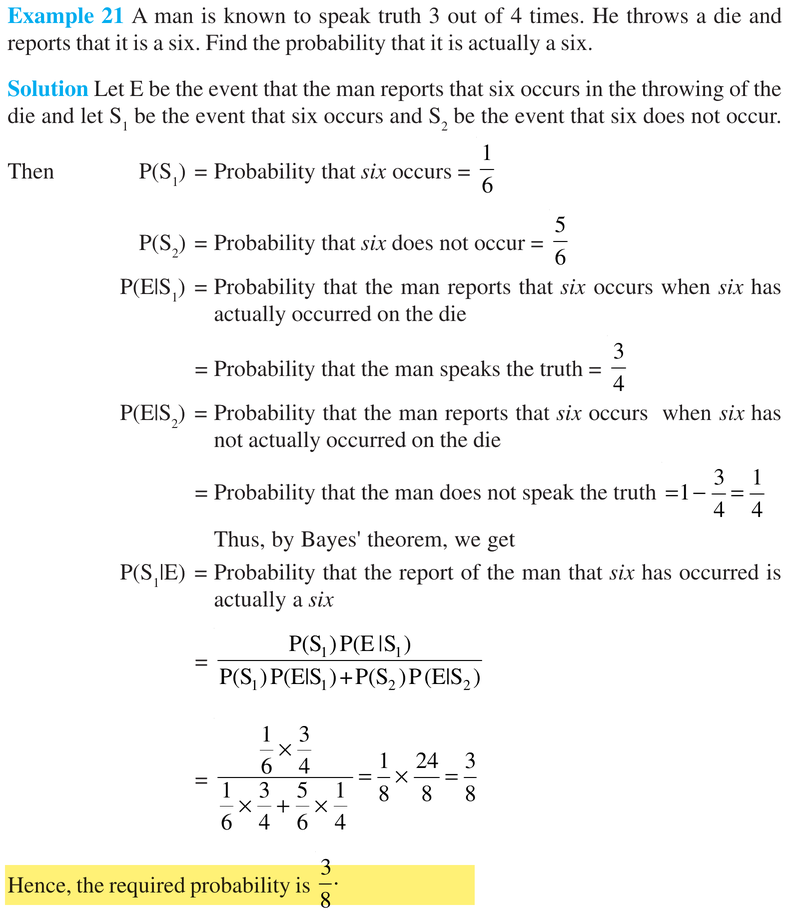
Let \(E_1\) be the event that a five occurs, \(E_2\) the event that it does not, and R the event that A reports a five.
\( \displaystyle P(E_1) = \frac{1}{6},\quad P(E_2) = \frac{5}{6} \)
If a five occurs, he reports a five when he speaks the truth. If it does not, he reports a five when he lies:
\( \displaystyle P(R \mid E_1) = \frac{4}{5},\quad P(R \mid E_2) = \frac{1}{5} \)
By Bayes’ theorem:
\( \displaystyle P(E_1 \mid R) = \frac{P(E_1)P(R \mid E_1)}{P(E_1)P(R \mid E_1) + P(E_2)P(R \mid E_2)} \)
\( \displaystyle = \frac{\frac{1}{6}\times\frac{4}{5}}{\frac{1}{6}\times\frac{4}{5} + \frac{5}{6}\times\frac{1}{5}} \)
\( \displaystyle = \frac{\frac{4}{30}}{\frac{4}{30} + \frac{5}{30}} \)
\( \displaystyle = \frac{4}{9} \)
NCERT (2026-27 edition):
Bayes' Theorem