
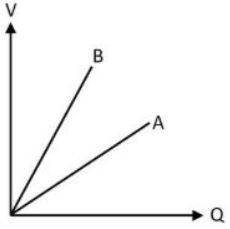
The graph shows the variation of potential difference between the plates of two capacitors A and B with the increase of charge stored by them. From the graph we can conclude:
Answer & explanation
Correct answer: option 1
The correct answer is Option (1) → Capacitance of A is greater than B
For a capacitor \( Q = CV \), so on a graph of \( V \) against \( Q \) the slope is
\( \displaystyle \frac{V}{Q} = \frac{1}{C} \)
Line B is steeper than line A, so \( 1/C_B \gt 1/C_A \), that is \( C_A \gt C_B \).
The stored energy can be written in two ways: \( U = \frac{1}{2}CV^{2} \) (useful at a given potential) and \( U = \frac{Q^{2}}{2C} \) (useful at a given charge).
Option (1) Capacitance of A is greater than B — Correct. The line of A has the smaller slope \( 1/C \), so A has the larger capacitance.
Option (2) Capacitance of B is greater than A — Incorrect. B has the steeper line, so its capacitance is the smaller one.
Option (3) B stores more electrostatic energy than A at a given potential — Incorrect. At the same \( V \), \( U = \frac{1}{2}CV^{2} \) is larger for the larger capacitance, which is A.
Option (4) A stores more electrostatic energy than B at a given charge — Incorrect. At the same \( Q \), \( U = Q^{2}/2C \) is larger for the smaller capacitance, which is B.
NCERT (2026-27):
Capacitors and Capacitance – “… Equation (2.38) shows that for large C, V is small for a given Q. This means a capacitor with large capacitance can hold large amount of charge Q at a relatively small V.”