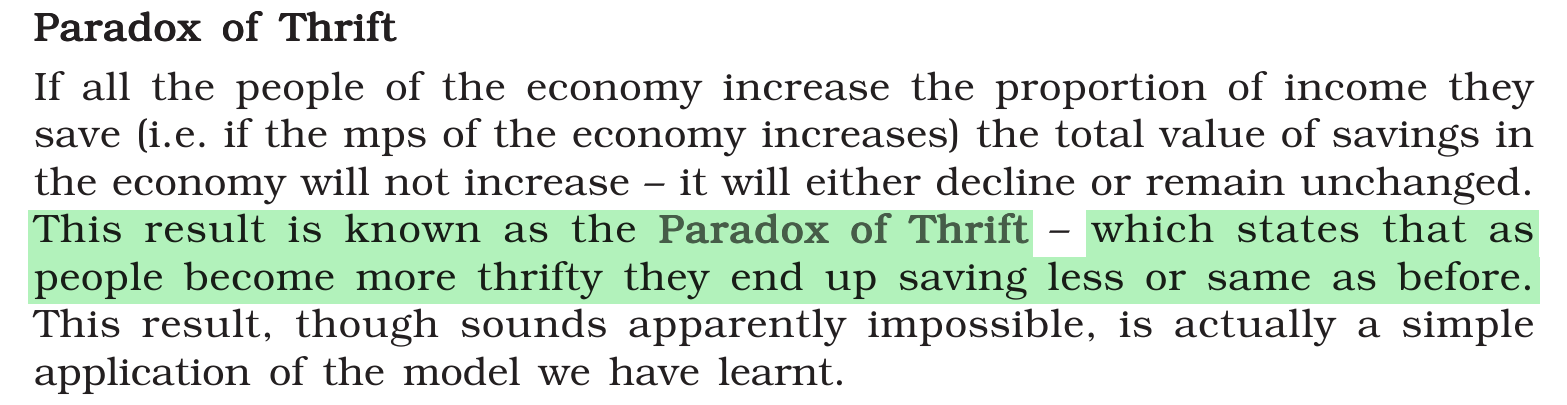
If all the people of the economy increase the proportion of income they save, the total value of savings in the economy will not increase - it will either decline or remain unchanged. This result is known as ......
Answer & explanation
Correct answer: option 2
The correct answer is Option (2) → Paradox of Thrift.
For one family, saving more is wise. But when all the people of the economy try to save a larger share of their income at the same time, the total saving of the economy does not increase: it stays the same or falls. A virtue for each household brings no gain to the economy as a whole, and this result is the paradox of thrift.
It comes from the way spending and income are linked:
Every household saves more, so consumption expenditure falls and aggregate demand falls with it.
Through the multiplier, equilibrium income falls by more than the original cut in consumption.
In equilibrium saving must equal planned investment, and investment is autonomous, fixed independently of income, so the economy ends up saving what it was saving before.
If investment itself falls as income falls, total saving ends up smaller than before.
Why the other options are incorrect
Option (1) Multiplier Mechanism. — Incorrect. The multiplier is the process by which a change in autonomous spending changes income by a larger amount. It is the mechanism through which the paradox works, not the name of the result.
Option (3) Deficient Demand. — Incorrect. Deficient demand is the situation in which equilibrium output is below the full employment level; more saving may cause it, but it is not the result about total saving.
Option (4) Investment. — Incorrect. Investment is the addition to the stock of capital; in this result it is the given amount that total saving must come back to equal.
Note: A same/similar question was asked in CUET (UG) in the papers below.
| 2026 | 2025 | 2024 | 2023 | 2022 |
| 11-05 S1* 13-05 S1* 21-05 S1* 06-06 S1* 07-06 S2* | 13-05 S1 30-05 S2* | – | – | – |
* A similar question.
NCERT (2026-27): Introductory Macroeconomics — Chapter 4: Determination of Income and Employment
|