


CUET Preparation Today
Find the intervals in which the function $f(x) = 20 - 9x+6x^2- x^3$ is strictly increasing or strictly decreasing. |
Strictly decreasing on $(−∞,1]∪[3,∞)$ and strictly increasing on $[1,3]$. Strictly increasing on $(−∞,1]∪[3,∞)$ and strictly decreasing on $[1,3]$. Strictly increasing on $(−∞,2)$ and strictly decreasing on $(2,∞)$. Strictly decreasing on $(−∞,2)$ and strictly increasing on $(2,∞)$. |
Strictly decreasing on $(−∞,1]∪[3,∞)$ and strictly increasing on $[1,3]$. |
The correct answer is Option (1) → Strictly decreasing on $(−∞,1]∪[3,∞)$ and strictly increasing on $[1,3]$. Given $f(x) = 20 - 9x+6x^2-x^3, D_f= R$. Differentiating w.r.t. $x$, we get $f'(x) = 0-9+12x-3x^2$ $=-3(x^2-4x+3)$ $=-3(x-1) (x-3)$.
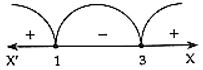
Now $f'(x) > 0$ iff $-3(x-1) (x-3) > 0$ $⇒(x-1) (x-3) <0$ $⇒ 1<x<3⇒x∈ (1,3)$ ⇒ f is strictly increasing in $[1, 3]$. And $f'(x) < 0$ iff $-3(x-1) (x-3) <0$ $⇒(x-1) (x-3) > 0$ $⇒ x < 1$ or $x > 3$ $⇒x∈ (-∞, 1) ∪ (3,∞)$ ⇒ f is strictly decreasing in $(-∞, 1] ∪ [3,∞)$. |