


CUET Preparation Today
Read the passage carefully and answer the questions. Amines are considered as derivatives of ammonia obtained by replacement of hydrogen atoms with alkyl or aryl groups. In nature they occur among proteins, vitamins, alkaloids and hormones. These can be primary, secondary or tertiary depending on the number of hydrogen groups replaced. They can be prepared from nitro compounds, alkyl halides, nitriles, amides etc. Due to unshared pair of electrons they behave as Lewis bases. Influence of the number of hydrogen atoms at nitrogen atom is displayed in physical properties such as solubility, boiling point and chemical reactions including basicity. Basic character of amines is expressed in terms of their $K_b$ and $pK_b$ values. Three classes of amines can be distinguished with p-toluene sulphonyl chloride which reacts with primary and secondary amines. Amino group when attached to benzene ring behaves as an activating and ortho para directing group. |
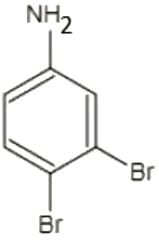
Give the IUPAC name of the compound
|
1,2-Dibromo-4-amino benzene 1,2-Dibromoaniline 1,2-Dibromoaminobenzene 3,4-Dibromoaniline |
3,4-Dibromoaniline |
The correct answer is Option (4) → 3,4-Dibromoaniline ** The compound is a benzene ring with an amino group (-NH₂) and two bromine atoms (-Br).
|