

Target Exam

CUET

Subject

Chemistry

Chapter

Organic: Alcohols, Phenols and Ethers

Question:

The reaction for the conversion of phenol into salicylic acid is known as

Options:

Reimer-Tiemann reaction

Kolbe's reaction

Claisen-condensation reaction

Etard reaction

Correct Answer:

Kolbe's reaction

Explanation:

The correct answer is Option (2) → Kolbe's reaction

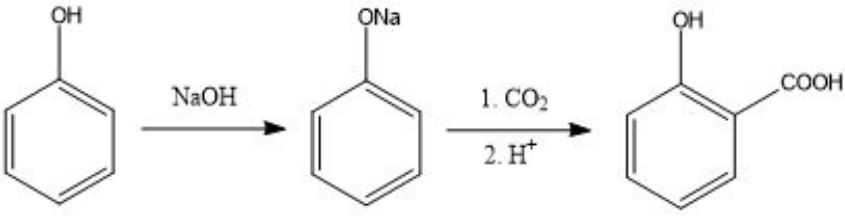
The reaction shown for the conversion of phenol into salicylic acid is known as the Kolbe-Schmitt reaction, or simply the Kolbe's reaction.

Reaction Summary

  1. Phenol reacts with a strong base like Sodium Hydroxide (NaOH) to form the highly reactive Sodium Phenoxide ion.
  2. The Sodium Phenoxide then undergoes an electrophilic substitution reaction with Carbon Dioxide ($CO_2$​) under elevated temperature and pressure (Carboxylation). The $CO_2$​ acts as a weak electrophile and attacks the ortho position, resulting in the formation of the sodium salt of salicylic acid (sodium salicylate).
  3. The final step involves acidification ($H^+$) to protonate the salt and yield Salicylic Acid (2-hydroxybenzoic acid).