


CUET Preparation Today
When aniline is reacted with benzoyl chloride, the correct product is |
N-Phenylbenzamide Biphenyl p-(Amino)phenylbenzoyl chloride N-Phenylaniline |
N-Phenylbenzamide |
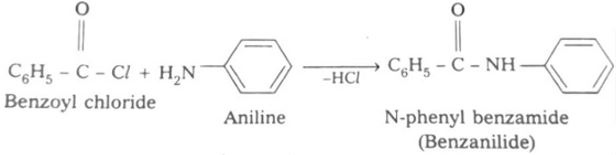
The correct answer is Option (1) → N-Phenylbenzamide Aniline ($C_{6}H_{5}NH_{2}$) is a primary aromatic amine. When it reacts with benzoyl chloride ($C_{6}H_{5}COCl$), an acylation reaction occurs. This reaction is known as the Schotten–Baumann reaction, in which an amine reacts with an acid chloride to form an amide. Reaction: $C_{6}H_{5}NH_{2} + C_{6}H_{5}COCl \rightarrow C_{6}H_{5}CONHC_{6}H_{5} + HCl$ In this process:
The product formed is $C_{6}H_{5}CONHC_{6}H_{5}$, which is called N-phenylbenzamide (also known as benzanilide). Thus, aniline reacts with benzoyl chloride to form N-phenylbenzamide.
Option 1: N-Phenylbenzamide This is the amide formed by benzoylation of aniline through the Schotten–Baumann reaction. Therefore, this option is correct. Option 2: Biphenyl Biphenyl is formed through coupling reactions such as the Ullmann reaction, not by reaction of aniline with benzoyl chloride. Hence incorrect. Option 3: p-(Amino)phenylbenzoyl chloride This compound is not formed in this reaction. Benzoyl chloride reacts with the amine group, not by substitution on the aromatic ring. Hence incorrect. Option 4: N-Phenylaniline This would require the coupling of two aniline molecules, which does not occur with benzoyl chloride. Hence, it is incorrect. |