


CUET Preparation Today
Sodium salts of carboxylic acids (RCOONa) when heated with sodalime, yield _____. |
$R-H$ $(R-COO)_2Ca$ $RCOONa$ $RCHO$ |
$R-H$ |
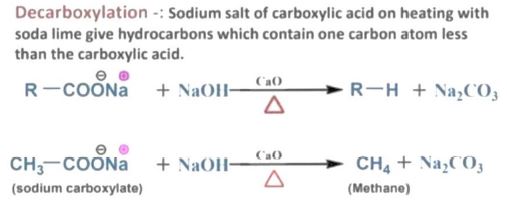
The correct answer is Option (1) → $R-H$ When sodium salts of carboxylic acids (RCOONa) are heated with sodalime, a decarboxylation reaction occurs. Sodalime is a mixture of: NaOH + CaO
In this reaction, the carboxyl group (–COO⁻) is removed as carbon dioxide, producing a hydrocarbon with one carbon atom less than the original carboxylic acid. General reaction: RCOONa + NaOH → RH + Na₂CO₃ (CaO, heat) Thus, the product formed is a hydrocarbon (RH). Example: CH₃COONa + NaOH → CH₄ + Na₂CO₃ Here, sodium acetate forms methane after decarboxylation. Therefore, sodium salts of carboxylic acids when heated with sodalime give alkanes (RH).
Option-wise Explanation Option 1: R – H During sodalime decarboxylation, the carboxyl group is removed as carbon dioxide and replaced by hydrogen, producing a hydrocarbon (RH) with one carbon less than the original acid. Therefore, this option is correct. Option 2: (R – COO)₂Ca This compound is a calcium salt of carboxylic acids, which forms when carboxylic acids react with calcium hydroxide. It is not the product of sodalime decarboxylation. Hence this option is incorrect. Option 3: RCOONa This is the reactant itself, not the product of the reaction. Therefore this option is incorrect. Option 4: RCHO RCHO represents an aldehyde, which is typically formed by mild oxidation of primary alcohols or by reduction of acid derivatives. Sodalime decarboxylation does not produce aldehydes. Hence this option is incorrect. |