


CUET Preparation Today
A manufacturer has three machines I, II and III installed in his factory. Machines I and II are capable of being operated for atmost 12 hours whereas machine III must be operated atleast 5 hours a day. He produces only two items M and N each requiring the use of all the three machines. The number of hours required for producing 1 unit of each of M and N on the three machines are given in the following table:
He makes a profit of ₹600 and ₹400 on each item of M and N respectively. How many units of each item should he produce so as to maximize his profit assuming that he can sell all the items that he produced? What will be the maximum profit? | |||||||||||||||
Produce 4 items of M and 4 items of N for a maximum profit of ₹4000. Produce 6 items of M and 3 items of N for a maximum profit of ₹4800. Produce 8 items of M and 2 items of N for a maximum profit of ₹5600. Produce 10 items of M and 0 items of N for a maximum profit of ₹6000. |
Produce 4 items of M and 4 items of N for a maximum profit of ₹4000. |
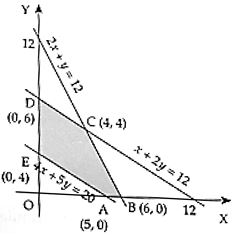
The correct answer is Option (1) → Produce 4 items of M and 4 items of N for a maximum profit of ₹4000. Let x units of item M and y units of item N are produced by the manufacturer, then the problem can be formulated as an L.P.P. as follows: Maximize the profit (in ₹) $Z = 600x + 400y$ subject to the constraints $x + 2y ≤ 12$ (machine I constraint) $2x + y ≤ 12$ (machine II constraint) $1x + 1.25y ≥ 5$ (machine III constraint) i.e. $4x+5y ≥ 20,$ $x ≥ 0, y ≥ 0$ (non-negativity constraints)
Draw the lines $x + 2y = 12, 2x + y 12, 2x + y = 12$ and $4x+5y = 20$, and shade the region satisfied by the above inequalities. The feasible region is the polygon ABCDE, which is convex and bounded. The corner points are A(5, 0), B(6, 0), C(4, 4), D(0, 6) and E(0, 4). The values of Z at the corner points are: at $A(5, 0), Z = 600 × 5+ 400 × 0 = 3000;$ at $B (6, 0), Z = 600 × 6 + 400 × 0 = 3600;$ at $C(4, 4), Z = 600 × 4 + 400 × 4 = 4000;$ at $D(0, 6), Z = 600 × 0 + 400 × 6 = 2400;$ at $E(0, 4), Z = 600 × 0 + 400 × 4 = 1600$. ∴ Maximum profit = ₹4000, when 4 items of M and 4 items of N are produced. |