


CUET Preparation Today
Benzylamine may be alkylated as shown in the following equation: C6H5CH2NH2 + R-X → C6H5CH2NHR Which of the following alkyl halides is best suited for this reaction through SN1 mechanism?
|
CH3Br C2H5Br C6H5CH2Br None of the above |
C6H5CH2Br |
The correct answer is option 3. \(C_6H_5CH_2Br\). Let us delve deeper into the reasoning behind why benzyl bromide \((C_6H_5CH_2Br)\) is best suited for the alkylation of benzylamine via the \(S_N1\) mechanism. Understanding the \(S_N1\) Mechanism The \(S_N1\) (unimolecular nucleophilic substitution) mechanism involves two main steps: Formation of a Carbocation: The leaving group (halide) departs, forming a carbocation. This is the rate-determining step and depends on the stability of the carbocation. Nucleophilic Attack: The nucleophile (in this case, benzylamine) attacks the carbocation, forming the final product. Carbocation Stability The stability of the carbocation intermediate is crucial for the \(S_N1\) reaction to proceed efficiently. The order of carbocation stability is as follows: Tertiary (3°) > Secondary (2°) > Primary (1°) Benzylic and allylic carbocations are highly stable due to resonance stabilization. Evaluation of Given Alkyl Halides Let us evaluate each alkyl halide in terms of the stability of the carbocation they would form: Forms a methyl carbocation
This is a primary carbocation and is highly unstable. Not suitable for \(S_N1\) mechanism. 2. Ethyl Bromide \((C_2H_5Br)\): Forms an ethyl carbocation
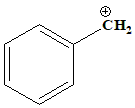
This is also a primary carbocation and is unstable. Not suitable for \(S_N1\) mechanism. 3. Benzyl Bromide \((C_6H_5CH_2Br)\): Forms a benzyl carbocation
This carbocation is highly stabilized by resonance. The positive charge can be delocalized over the aromatic ring, making it very stable.
Very suitable for \(S_N1\) mechanism due to the high stability of the benzylic carbocation. Resonance Stabilization: In the case of benzyl bromide: The carbocation formed is stabilized through resonance. The positive charge can be delocalized over the aromatic ring, as shown in multiple resonance structures. Conclusion: Given the need for a stable carbocation in the \(S_N1\) mechanism, benzyl bromide \((C_6H_5CH_2Br)\) is the best alkyl halide for the alkylation of benzylamine through this pathway. The stability provided by the resonance in the benzylic carbocation makes this reaction proceed efficiently. |